
Exploring Unit 1 Origins: Essential Historical Thinking Skills for Global History Students

The origins unit in a global history curriculum sets the foundation for students to develop critical historical thinking skills. This first unit is more than just a collection of facts about early human societies or ancient civilizations. It prepares students to analyze, question, and understand history in ways that will support their success in advanced placement courses and beyond.

Building Historical Thinking Skills
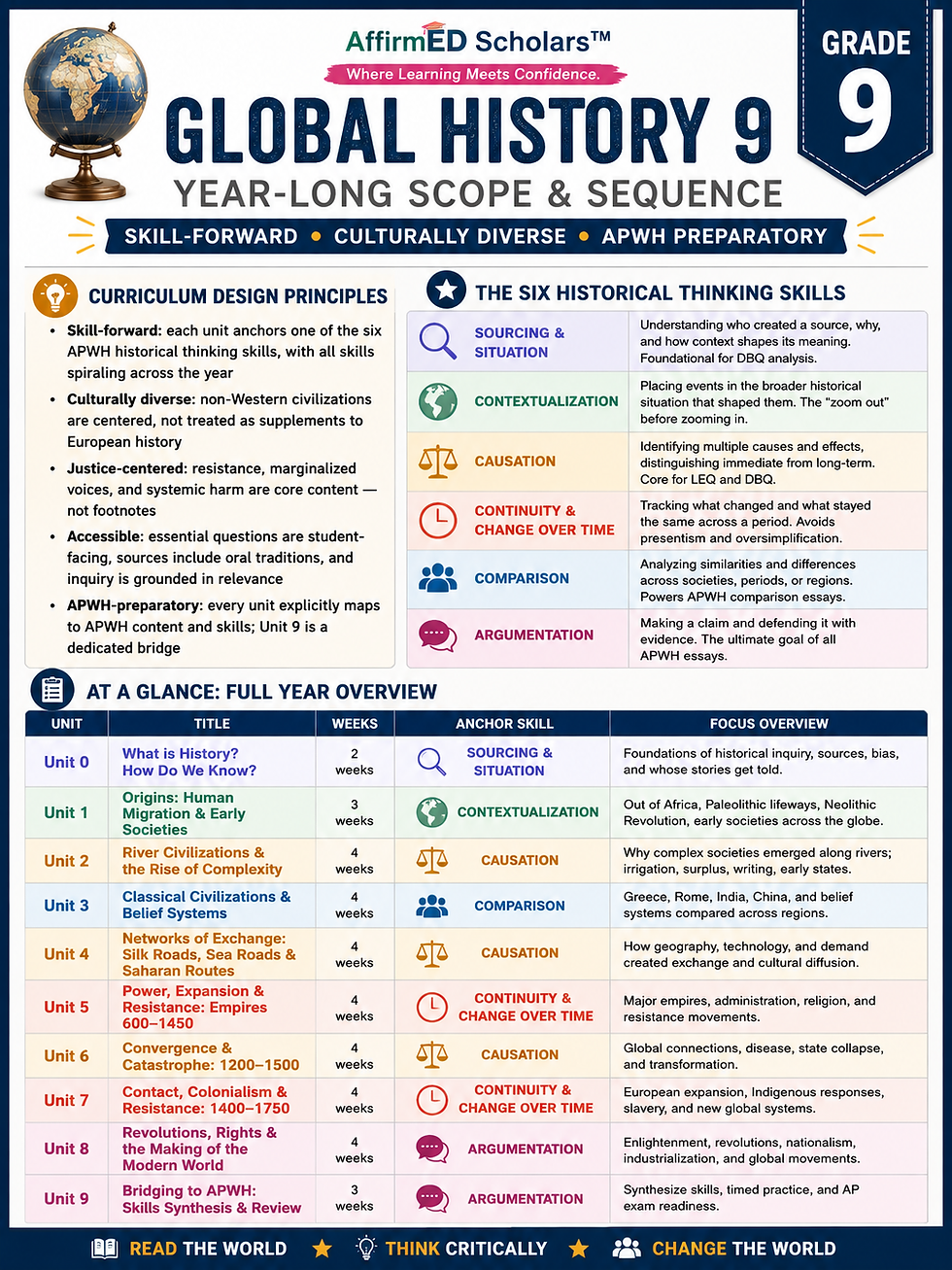
The origins unit introduces students to key skills that historians use to study the past. These include:
Analyzing primary and secondary sources
Students learn to distinguish between firsthand accounts and later interpretations. For example, examining ancient texts alongside modern archaeological reports helps students understand how evidence shapes historical narratives.
Understanding cause and effect
The unit explores how early developments, such as the Agricultural Revolution, led to changes in human societies. Students trace how these origins influenced social structures, economies, and cultures.
Recognizing continuity and change over time
Students identify what aspects of early human life remained constant and what evolved. This skill is vital for connecting ancient history to later periods.
Developing historical argumentation
The curriculum encourages students to form evidence-based conclusions. For instance, they might debate the impact of early trade networks on cultural exchange.
These skills are essential for navigating more complex history units later in the course, where students encounter diverse regions and themes.
Integrating the Origins Unit into the Curriculum
The origins unit fits naturally at the start of a global history curriculum. It provides context for understanding the broad patterns that shape human history. Educators can enhance this unit by:
Using interactive timelines to help students visualize key events and developments.
Incorporating map analysis to show migration patterns and the spread of ideas.
Assigning project-based learning tasks, such as creating models of early settlements or presenting on ancient technologies.
These activities make the origins unit engaging and help students apply historical thinking skills actively.
Preparing Students for Advanced Placement
The origins unit also serves as a stepping stone for students aiming to succeed in advanced placement global history courses. It introduces the analytical mindset required for AP exams, such as:
Evaluating multiple perspectives on historical events.
Writing clear, concise essays supported by evidence.
Making connections across different regions and time periods.
By mastering the origins unit, students build confidence and a strong foundation for tackling more challenging history units.
Encouraging a Global Perspective
A key goal of the origins unit is to foster a global perspective. Instead of focusing on a single civilization, the curriculum highlights early human experiences worldwide. This approach helps students appreciate diversity and understand how interconnected human history is.
For example, comparing the development of agriculture in Mesopotamia, the Nile Valley, and the Indus Valley reveals both unique adaptations and shared innovations. This comparison encourages students to think beyond national or cultural boundaries.


Comments