
Exploring Unit 2: The Impact of River Civilizations on Global History

Rivers have shaped human history in profound ways. In global history education, the study of river civilizations reveals how early societies harnessed natural resources to build complex cultures, economies, and political systems. This unit offers educators a rich opportunity to connect students with the foundations of civilization and the ongoing influence of geography on human development.
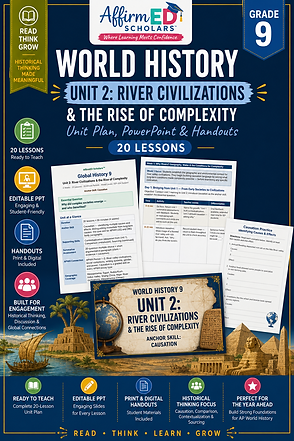
The Role of Rivers in Early Societies
Rivers provided more than just water. They offered fertile soil through annual flooding, enabling agriculture to flourish. This agricultural surplus allowed populations to grow and societies to specialize in various trades and crafts. For example, the Tigris and Euphrates rivers supported Mesopotamia, often called the cradle of civilization, where writing, law codes, and urban centers first appeared.
Key contributions of river civilizations include:
Agricultural innovation: Irrigation systems and crop management techniques.
Trade and transportation: Rivers served as natural highways connecting distant communities.
Political organization: Centralized governments emerged to manage water resources and land distribution.
Cultural development: Religion, art, and writing often centered around rivers and their cycles.
These developments laid the groundwork for many aspects of modern society.
Major River Civilizations Covered in the History Curriculum
Educators will find that focusing on specific river civilizations helps students grasp the diversity and commonalities among early cultures. Some of the most influential river civilizations include:
Mesopotamia (Tigris and Euphrates Rivers)
Located in present-day Iraq, Mesopotamia introduced:
The earliest known writing system, cuneiform.
The Code of Hammurabi, one of the first legal codes.
City-states like Ur and Babylon, which demonstrated early urban planning.
Ancient Egypt (Nile River)
The Nile’s predictable flooding supported:
Monumental architecture such as pyramids and temples.
A centralized theocratic government led by pharaohs.
Advances in mathematics and medicine.
The Indus Valley (Indus River)
In modern Pakistan and northwest India, the Indus Valley civilization featured:
Well-planned cities like Harappa and Mohenjo-Daro.
Sophisticated drainage and sewage systems.
Trade networks extending to Mesopotamia.
Ancient China (Yellow River)
The Yellow River basin saw:
The rise of dynasties such as the Shang and Zhou.
Early development of Chinese writing.
Innovations in bronze casting and agriculture.
Teaching Strategies for River Civilizations in the History Curriculum
To engage students with this unit, educators can use a variety of approaches:
Map analysis: Have students trace river courses and identify key cities and regions.
Primary sources: Introduce excerpts from ancient texts like the Epic of Gilgamesh or Egyptian hieroglyphs.
Comparative studies: Encourage students to compare political structures, religious beliefs, and technologies across river civilizations.
Project-based learning: Assign research projects on irrigation techniques or trade routes.
Visual aids: Use images, diagrams, and models to illustrate river flooding and city layouts.
These methods help students connect historical facts with human experiences and environmental factors.
The Lasting Influence of River Civilizations
The legacy of river civilizations extends beyond their time. Many modern societies still rely on rivers for agriculture, transportation, and cultural identity. Understanding these ancient societies helps students appreciate:
How geography shapes human activity.
The origins of writing, law, and governance.
The importance of managing natural resources sustainably.
By integrating river civilizations into the history curriculum, educators provide students with a foundation for understanding global history’s complexity and continuity.



Comments